
Pharmacognosy Today: Innovations, Challenges, and Future Directions in Natural Drug Research

Pharmacognosy is the branch of Pharmacy / Pharmaceutical sciences, that deals with the study of crude drugs obtained from the natural sources like plant, animals, marine, and microorganisms.
Pharmacognosy is defined as the systemic & scientific study of crude drugs along with the cultivation, collection, preparation, and storage.
The word “pharmacognosy” was coined by the german scientist C.A. Seydler in 1815. The term “pharmacognosy” is derived from two Greek words: “pharmakon,” which means “drug,” and “gnosis,” which means “knowledge.”
Recently, people depended on herbal medicine or herbs for treatment because of less side effects.
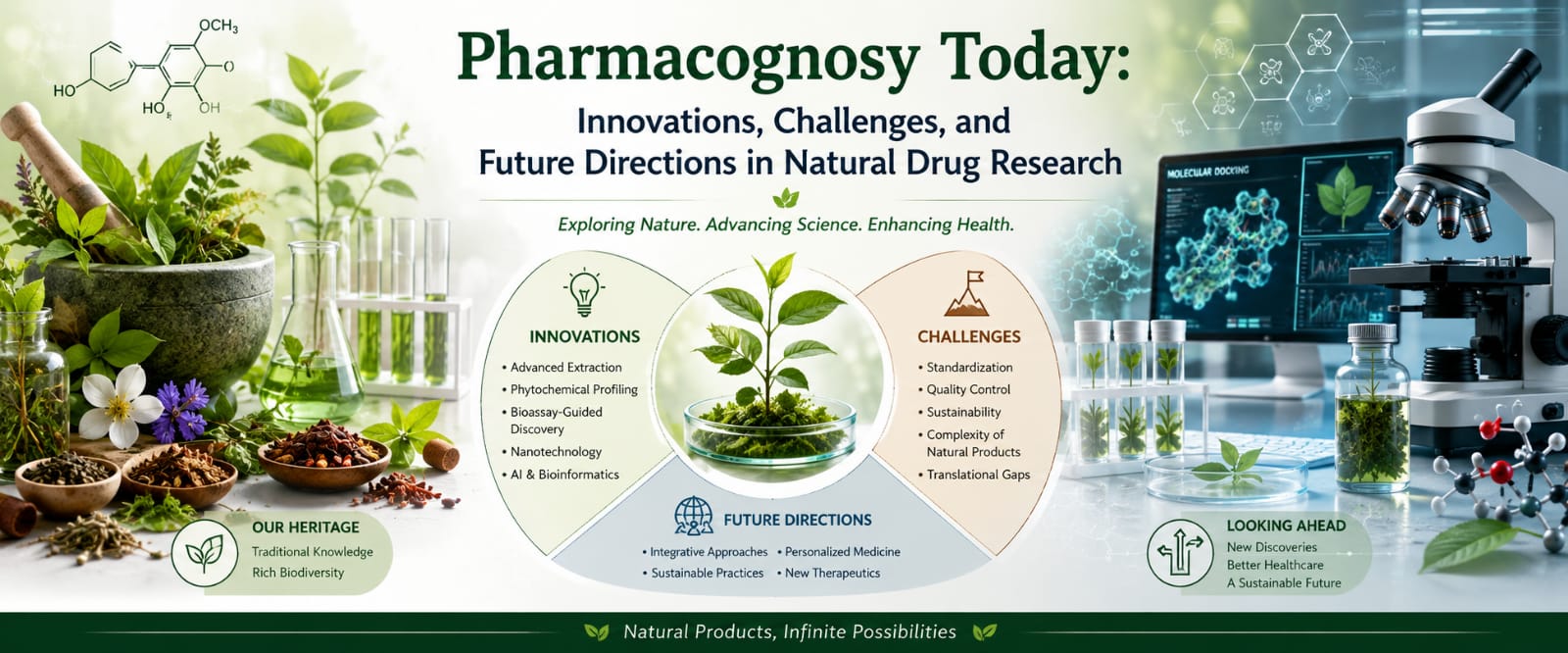
Nowadays, modern medicines are prepared from natural sources. In the 21st century, pharmacognosy has advanced technologies to identify medicinal plants & chemical constituents.
Techniques such as finger printing, chromatography, spectroscopy and biotechndogy are used for the identification & standardization or authotication of medicinal plants. These techniques helps to detect the adulteration & maintain the purity & qualityof herbal drugs. With the help of medicinal plants, many diseases, such as cancer and diabetes, are being studied.
Pharmacognosy growing rapidly, but it also faces some problems like adulteration of drugs, lack of standardization and overuse of medicinal plants without proper knowledge.
The future of pharmacognosy is very wide because the high demand for natural medicines or herbal medicines is increasing every year. Pharmacognosy also has a bright future in the pharmaceutical, cosmetic, nutraceutical, and herbal industries. Pharmacognosy can help in developing cheaper, safer & effective medicines for the future.
In conclusion, Pharmacognosy play an important role in the 21st century. It combines traditional knowledge with modern techniques for the development of herbal medicines & to improve the healthcare system. The growing demand for natural medicines. help to development of safer, cheaper and more effective treatments in the future.